Click the link to view the full version: WASCZ | Li Auto Leaders’ Talk: What Kind of Young People Do We Need for Future “Smart” Manufacturing?
As intelligent manufacturing and AI reshape various industries, how should today’s education prepare children for their future? In December, WASCZ hosted a special cross-industry dialogue. Three distinguished guests from Li Auto—Mr. Luo Ping, Head of Parts Cluster, Mr. Wei Yan, Director of Manufacturing Operations, and Ms. Li Aoran, Talent Development Specialist—visited the campus to present an in-depth industry talk that blended advanced manufacturing concepts with a forward-looking vision for the future. Rooted in academic foundations, they guided students in exploring industry trends and reflecting on future changes.
Mr. Luo Ping | Head of Parts Cluster
A graduate of the University of Applied Sciences Dresden (HTW Dresden) in Germany, Mr. Luo holds a Bachelor’s degree in Mechanical Engineering and a Master’s in Production Technology. With 19 years of experience in the automotive industry, he has previously served as the Deputy General Manager of Engine Systems at Geely, and the Director of Engine System Development at SAIC Volkswagen Dalian. He is currently the Head of Parts Cluster at Li Auto and is also a parent at WASCZ.
Mr. Wei Yan | Director of Manufacturing Operations
Mr. Wei holds a Bachelor’s degree in Mechanical Design, Manufacturing, and Automation from Harbin Institute of Technology and a Master’s degree in Industrial Engineering from Tongji University. With 23 years of experience in the automotive industry, he currently serves as the Director of Manufacturing Operations at Li Auto. His areas of expertise include manufacturing analysis, vehicle planning and introduction, manufacturing processes, and operational management.
Ms. Li Aoran | Talent Development Specialist
Ms. Li holds a Bachelor’s degree in Business Administration from Beijing Institute of Technology and a Master’s degree in Public Human Resource Management from the University of Birmingham, UK. With extensive experience in human resources, she has worked as an HR business partner (HRBP) for Kuaishou’s algorithm department and is now a Talent Development Specialist at Li Auto.
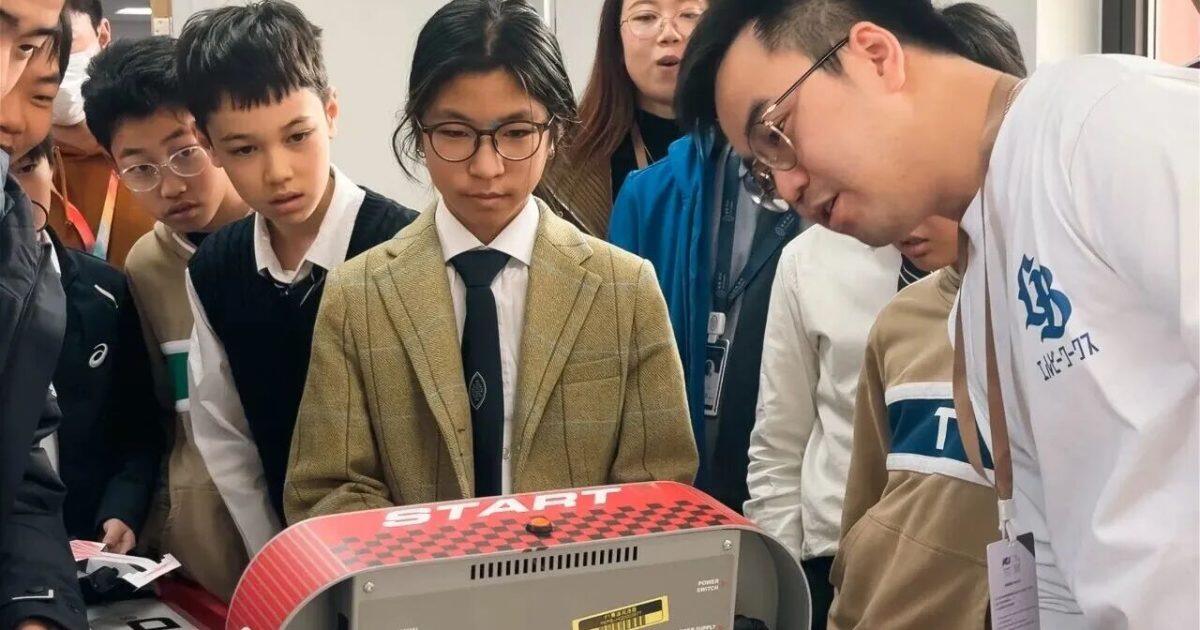
During the lecture, Ms. Li Aoran provided a systematic breakdown of the entire modern car manufacturing process and vividly demonstrated Li Auto’s cutting-edge practices in smart algorithm applications. Her engaging explanations sparked students’ curiosity and thirst for knowledge—ranging from professional discussions on topics like “the use of carbon fibre in car manufacturing” and “the range issues of new energy vehicles,” to speculative questions about “whether Li will launch a sports car in the future.” Mr. Luo Ping and Mr. Wei Yan patiently addressed all the students’ questions. They emphasised that in the future, the application of software, algorithms, and AI technologies will not only drive the development of new energy vehicles, but will also become core considerations in evaluating future talent.
In the subsequent interview session, we engaged in a deeper discussion with the three experts about industry trends and talent development:
Q1: What do you think are the development trends in the automotive manufacturing industry, and how will these trends impact individuals?
Mr. Wei Yan:
Based on our own judgement and the national “Smart Manufacturing 2025” plan, we believe the industry will evolve through three key stages:
The first stage is automation, which is already well-developed, with many automated devices now in factories. The next step will be digitalisation, where all production processes, techniques, and equipment parameters will be converted from analogue signals to digital signals. Many business transactions will also be conducted digitally, transforming factories into digital ones.
But what is the purpose of a digital factory? It’s all about achieving intelligent manufacturing. In the future, more algorithms and AI technologies will enter the manufacturing sector, and we may see machines making their own analyses and decisions, requiring fewer human workers. AI will also help predict production outcomes, improving both quality and delivery speed. So, we see this as a relatively certain direction for the future of automotive manufacturing.
Q2: For students who aspire to enter the automotive manufacturing industry, what academic background and skills do you think they should have? As emerging technologies develop, what areas should they focus on?
Mr. Wei Yan:
The automotive industry covers a wide range of disciplines. Whether traditional fields or newer ones, there are always opportunities, and it really depends on what the students are passionate about. For instance, mechanical engineering, electronics, and electrical engineering are traditional fields, but they are constantly evolving.
You can also see that AI and algorithms are becoming key components for future manufacturing. Ultimately, it’s about finding what suits and interests you. Now, most disciplines are more interlinked, and new technologies emerge from these intersections. For students, it’s crucial to follow their own interests.
Mr. Luo Ping:
Traditionally, if you studied automotive engineering, mechanical engineering, or internal combustion engine technology, you would likely enter the automotive sector. However, today, automotive companies involve many functions—design, styling, manufacturing, sales, and even departments like HR, legal, and finance. To keep a company running smoothly, all fields are needed.
In R&D, we have traditional mechanical design, electronic materials, and physics-based designs, as well as algorithm development. At the software level, some of our design work is done by art schools. We also have many colleagues in marketing, many of whom come from humanities backgrounds. They help define and communicate the product’s value. So every discipline has a role in the automotive industry.
Q3: With the progress of the automotive industry, what new skills or competencies will future automotive engineers need?
Mr. Wei Yan:
For today’s engineers, the biggest challenge is learning how to use AI tools effectively to increase productivity. This requires engineers to not only master technical skills but also understand AI applications. They need to know what AI can do, which models to apply, and how to create intelligent workflows that integrate with their tasks. The future will be a world where humans and machines coexist, so we must embrace this change.
Mr. Luo Ping:
In the past two years, Li Auto has integrated many AI applications. For instance, in production scheduling, the traditional method involved entering sales forecasts into spreadsheets or IT systems, then manually calculating material relationships before arriving at a production plan. Without AI, this process could take engineers a whole day.
But now, we’ve embedded these tasks into an AI workflow, making it possible for AI to handle the job in just a few minutes. AI tools significantly improve efficiency and quality, which is why we actively push for AI implementation. AI is often referred to as the fourth industrial revolution, so learning to harness it is crucial for employees and businesses alike.
Q4: From a corporate perspective, aside from professional skills, what qualities or soft skills do you value when selecting future talent?
Mr. Wei Yan:
For me, the most important qualities are:
A proactive mindset—always taking the initiative and moving forward. This mindset helps one step into new areas and keep growing.
Continuous learning—both businesses and individuals are in constant growth. The world doesn’t change overnight; it evolves gradually. Continuous learning keeps you ahead.
Collaboration—modern industries are complex, and no one person can do everything alone. Good teamwork is essential, and for that, strong communication skills are crucial.
Additionally, the ability to see the bigger picture is vital. Developing cognitive skills helps you see further and adjust your behaviour accordingly.
Mr. Luo Ping:
Innovation is also a key consideration—how to apply innovative thinking and perspectives to your work or the value you create.
Optimisation has limited growth potential, and many problems need creative solutions. Think of Steve Jobs introducing the touchscreen iPhone and an entirely new operating system, or Elon Musk’s SpaceX, which rethought rocket manufacturing costs and pioneered reusable rockets. What truly drives progress is finding creative solutions to fundamental problems.
We hope that our employees and students will cultivate an innovative mindset, pushing projects and future learning with new ideas.
Ms. Li Aoran:
The two speakers have focused on more macro-level factors, but from my own experience as someone relatively new to the workforce, I feel that in such a rapidly developing society, companies are also moving fast, and we constantly face new challenges. Therefore, I believe the first thing is to maintain a stable mindset. When companies select talent, they often look for a strong foundation, and your mindset plays a big part in that.
Once you enter a company, stay proactive in tackling new projects and meeting new people. Each challenge is an opportunity for growth, which will lead to greater value and personal progress.
The second point is to adopt a problem-solving attitude. I work in a relatively new department, with many “zero to one” projects, and there are moments of great difficulty. If you maintain a positive, problem-solving mindset, you’ll gain greater rewards in both your work and personal development.
After discussing industry trends, Mr. Luo Ping also returned to his important role as a parent at WASCZ, sharing his thoughts on education choices:
Q5: Have you seen significant progress or change in your child since joining our school, and do you think this will benefit their future development?
Since my child started studying here last year, I’ve noticed that his academic expectations of himself have risen. After joining such an excellent environment, he’s eager to integrate and show his abilities among many talented peers. This is a clear sign of his strong self-motivation.
WASCZ has also provided him with many extracurricular opportunities, such as his passion for debating. He and his friends recently formed a team to participate in a debate, and he told me, “We did really well against the older students.” I believe his confidence and focus on academics have greatly improved.
Q6: As a parent, what suggestions do you have regarding how schools can collaborate with enterprises or industries to help students better plan their future directions?
When it comes to school-enterprise cooperation, I believe that most companies, especially leading and reputable ones, have the social responsibility and the vision to provide children with more information and knowledge.
At the primary and secondary school level, at Li Auto, we place great emphasis on helping the next generation understand society and various industries early on. Therefore, I think that as long as schools have this intention and actively engage with different companies, building such bridges is not difficult. From the company’s perspective, we are also very eager to offer these opportunities, allowing more children to visit enterprises, learn about companies, and gain a better understanding of how society functions and operates.
Just as Mr. Wei Yan mentioned, the future will be a world of “human-machine coexistence,” and embracing change has become a requirement for everyone in this era. From the cutting-edge trends of “AI-enabled manufacturing” to discussions about the future skill sets of talent—such as “innovation, collaboration, and continuous learning”—these concepts resonate deeply with the holistic education philosophy practiced at WASCZ.
We firmly believe that the mission of education is not just to impart knowledge, but to shape the character and mindset needed to navigate change and lead transformation. At WASCZ, the goal of holistic education is not only to cultivate each child’s ability to adapt to change but also to shape them into leaders for the future. We aim to nurture students who will grow into thoughtful thinkers, brave change-makers, and innovative builders in the new generation of technological revolutions.
More News