Click the link to view the full version: WASCZ | From Atoms to”Artificial Sun”: A Scientific Journey to Hefei
In just three days, our students journeyed from the frontiers of the microscopic world to humanity’s ultimate energy dream — a path less traveled, and a journey to remember.
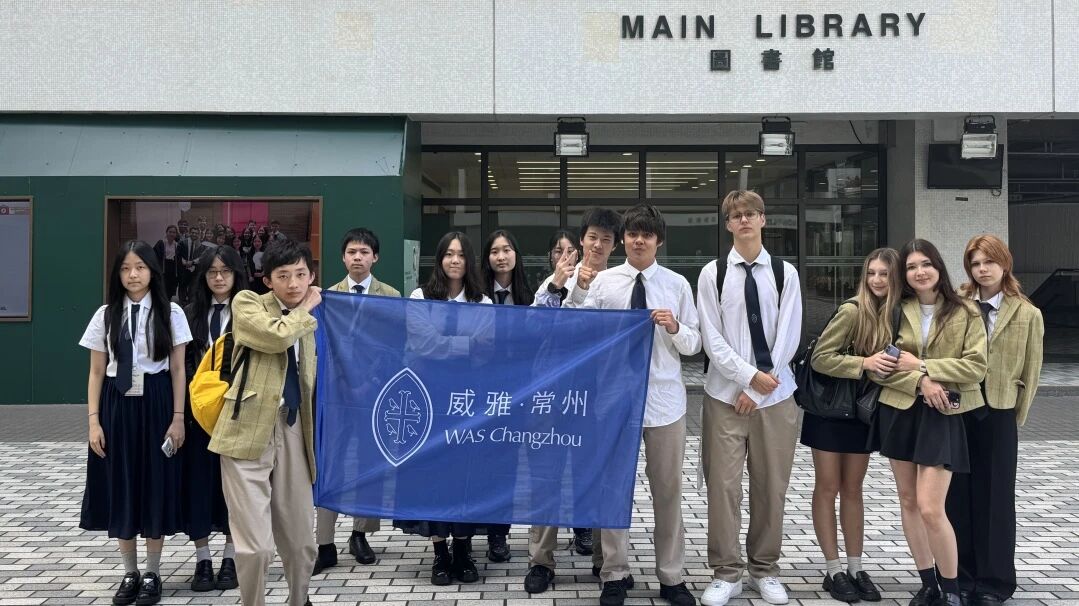
21 students from WASCZ, accompanied by 3 teachers, set foot on the innovative soil of Hefei — a city at the forefront of China’s scientific and technological advancement. This was no ordinary sightseeing tour, but a profound, immersive exploration that brought students into real laboratories, alongside mega-science facilities, and face to face with the cutting edge of research.
01
USTC|The Atomic World Up Close
Our first stop was the Physics and Chemistry Science Experiment Center at the University of Science and Technology of China (USTC).
Before the world’s most advanced double aberration-corrected transmission electron microscope, our students held their breath. This “scientific eye”, valued at tens of millions of yuan, can capture crystal structures at atomic resolution — abstract textbook concepts now vividly displayed as clearly visible atomic arrangements on the screen. One student whispered in awe:”So atoms really do look like that.”
The center’s faculty directors and senior staff personally served as our guides, explaining everything from scanning electron microscopes and atomic force microscopes to nuclear magnetic resonance spectrometers — each instrument’s working principles and cutting-edge applications presented in plain language. Through vivid analogies and engaging research stories, the students found themselves captivated by the “heavy artillery” of scientific discovery, touching the very instruments that once existed only in their textbooks.
02
Science Island|Standing Beneath the “Artificial Sun”
Day two brought us to the highlight of the tour — Hefei Science Island, home to the Hefei Institutes of Physical Science, Chinese Academy of Sciences, and the heart of China’s nuclear fusion research.
The Fusion Innovation Exhibition Hall at the CRAFT (Comprehensive Research Facility for Fusion Technology) park was our first stop. Through detailed exhibits and device models, students traced China’s fusion research journey — from following, to keeping pace, and now to leading the world. The stories of early scientists who built the field from scratch in challenging conditions moved many to reflection:”So every great scientific achievement was built on generations of dedication.”
Then came the moment we had all been waiting for — stepping into the main hall of the EAST (Experimental Advanced Superconducting Tokamak) facility. EAST is the world’s first fully superconducting tokamak — China’s very own “Artificial Sun”. Standing beneath this 11-meter-tall, 400-ton giant, our students gazed up at the intricate superconducting coils and precision equipment, their faces filled with awe. Staff explained the machine’s working principles in accessible terms, and when they mentioned that plasma temperatures can reach 160 million degrees Celsius — ten times hotter than the Sun’s core — a collective gasp echoed through the hall.
“The Experimental Advanced Superconducting Tokamak (EAST). I had come across this name countless times in textbooks and news reports. It always sounded complicated and distant. But when it finally stood before me, the sense of awe was far greater than I had imagined. It was enormous, like something lifted straight out of a science fiction film. Beneath its metallic shell lay an intricate network of pipes and systems, while its immense ring-shaped structure rested quietly in the centre of the experimental hall, like a sleeping giant.
We stood at a distance, listening as the guide’s voice echoed through the hall, accompanied by the faint crackle of the loudspeaker. She spoke of plasma heated to over 100 million degrees, of magnetic confinement, and of humanity’s ultimate pursuit of clean energy. The concepts felt both unfamiliar and profoundly inspiring. I found myself imagining a world fifty years from now, where clean fusion energy might power everyday life. Perhaps by then we would have grown old, and the tokamak would finally have fulfilled the purpose for which it was created. I fixed my eyes on its circular form, trying to picture what it would look like in operation—a man-made, carefully controlled solar storm raging within.
At that moment, I realised that science does not have to reveal its final results for us to appreciate its beauty. Simply standing there, witnessing humanity’s attempt to recreate the power of a star here on Earth, was enough to fill me with wonder. As we left, I turned back for one last look. The building stood quietly beside the lake, like a silent promise—of the future, of possibility, and of the stars that our generation may one day reach.”
—— Excerpt from the Study Trip Journal of E. Sun, Grade 9
03
BYD|Driving into the Future of New Energy
Leaving Science Island, we headed to BYD. Unlike conventional automotive factories, this is a world driven by technological innovation.
Guided by BYD staff, we toured the factory and technology exhibition halls, gaining a comprehensive understanding of the company’s breakthroughs in battery technology, vehicle manufacturing, and intelligent connectivity. Students observed the efficient operation of modern production lines, witnessing firsthand the powerful transformation from “Made in China” to “Created in China”. From the first domestically developed battery to today’s globally bestselling new energy vehicles, BYD’s growth story gave our students a tangible sense of the power behind technological innovation.
04
Anhui Science and Technology Museum|Science You Can Play With
On our final day, we visited the Anhui Science and Technology Museum — the first museum in China to feature a dedicated quantum exploration hall.
What makes this museum unique is that nearly every exhibit invites hands-on interaction. In the “Scientific Journey” hall, students operated classic physics experiments with their own hands. In the “Quantum Exploration” hall, abstract concepts like quantum superposition and entanglement were transformed into immersive interactive experiences. In the “Heaven and Earth Mystery” hall, the vastness of astrophysics sparked limitless imagination.
Throughout the visit, our guide provided meticulous interpretations, explaining cutting-edge topics — from quantum key distribution to tokamak magnetic confinement and cosmic microwave background radiation — in clear, accessible language. This was no hurried, checklist-style tour; it was a journey of thoughtful exploration and hands-on discovery.
05
Beyond Knowledge|What Textbooks Can’t Teach
“This trip not only broadened my horizons, but also ignited my passion for science and for exploring the unknown,” said D. Han, a Grade 9 student. Three days, compact but rich. Our students glimpsed a world far beyond their textbooks and came to appreciate the spirit of scientific researchers — their rigorous scholarship, their willingness to endure solitude, and their relentless pursuit of excellence.
The beauty of science lies not only in precision instruments and grand facilities, but in every moment of curiosity and every question of “why”. We believe that what our students saw, heard, and felt these three days will one day become a beam of light illuminating their paths ahead.
A nation’s strength lies in its science and technology; a nation’s future lies in its youth. The journey of exploration never ends.
More News